
The technical migration is the part organisations prepare for. The four things that actually derail it are not technical.
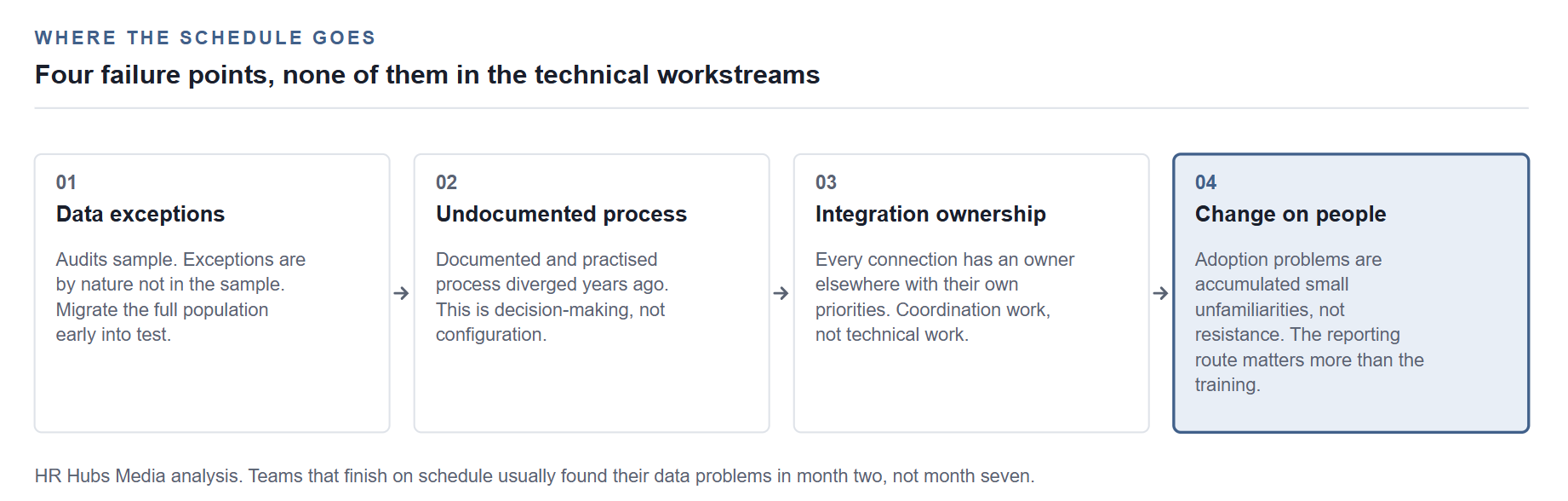
Every migration plan has data, integration and testing workstreams, and those are usually managed competently. These four sit outside them.
Every HR system migration has a project plan with a data migration workstream, an integration workstream and a testing workstream. Those workstreams are usually managed competently. The migrations that go badly rarely fail on any of them.
1. The data is worse than the audit suggested
Legacy HR data accumulates decades of exceptions: employees with two records from an acquisition, job titles that exist nowhere in the job architecture, historical leave balances calculated under a policy nobody can locate.
A data audit typically samples. The exceptions are, by nature, not in the sample.
The practical protection is to migrate a full population early into a test environment rather than a clean subset, and to budget explicit time for exception handling as a named workstream rather than as contingency. The organisations that finish on schedule are usually the ones that discovered their data problems in month two rather than month seven.
2. The process was never actually documented
A migration forces every HR process to be written down, frequently for the first time. Teams routinely discover that the documented process and the practised process diverged years ago, that three regions handle the same event differently, and that a critical approval step exists only because one person has always done it.
This is genuinely valuable, and it is also the phase where timelines slip, because the organisation is not configuring a system, it is deciding how it wants to operate. Treat that decision-making as a distinct phase with its own time allowance, not as a configuration task.
A migration schedule that allocates time to configuration but none to deciding how the organisation wants to work has already slipped. It just does not know yet.
3. Nobody owns the integrations at the other end
The HR system connects to payroll, finance, identity management, learning, benefits providers and often to systems nobody has documented. Each connection has an owner elsewhere in the organisation with their own priorities and change windows.
The integration workstream is therefore not primarily technical work, it is coordination work across teams that do not report to the project.
Identify every downstream consumer of employee data early, including the informal ones, such as the manager who receives a monthly export nobody in IT knows about. Those informal consumers are also, incidentally, a data protection exposure that a migration is a good opportunity to close.
4. The change lands on people who did not ask for it
Employees and managers experience a migration as a set of things that used to work and now do not. Adoption problems are usually not resistance, they are the accumulation of small unfamiliarities at a moment when people also have their actual jobs to do.
The teams that handle this well communicate what changes for each specific audience rather than announcing the project, and they keep a visible, responsive route for reporting problems in the first weeks. The route matters more than the training, because it is what prevents a small defect becoming the story of the whole migration.
The realistic view
A migration is an organisational change with a technology component, and the schedules that hold are the ones built on that understanding.
The system will do what it is configured to do. Whether the organisation is ready to be configured is the harder question, and it is worth asking honestly before the timeline is committed.
One question worth asking before you sign. Ask your vendor and your integrator for a reference customer of similar size and complexity, and ask that customer specifically what took longer than planned. Not whether they were satisfied. What took longer, and why.
This is reporting on workplace technology and operations. It is not legal, employment or procurement advice.
References
Every figure and legal citation in this article is drawn from the sources below. Where an instrument is proposed rather than in force we say so in the text.
European Union, Regulation (EU) 2016/679, the General Data Protection Regulation, on processing employee personal data. https://eur-lex.europa.eu/eli/reg/2016/679/oj
Government of India, The Digital Personal Data Protection Act, 2023. https://www.meity.gov.in/data-protection-framework
How we work. This article was researched and written by the HR Hubs Media editorial team. We do not republish press releases. Every number and legal citation is checked against a primary source, which is named and linked above. Where an instrument is proposed rather than in force, we say so. Corrections are made openly on the article itself, never by silent edit. If you believe something here is wrong, write to info@hrhubsmedia.com and tell us what and why.
Filed under Core HR (HCM / HRIS) · Get The Weekly Brief