
This is the specification for research we have not yet run, published openly, because a benchmark whose method arrives after its findings is not a benchmark.
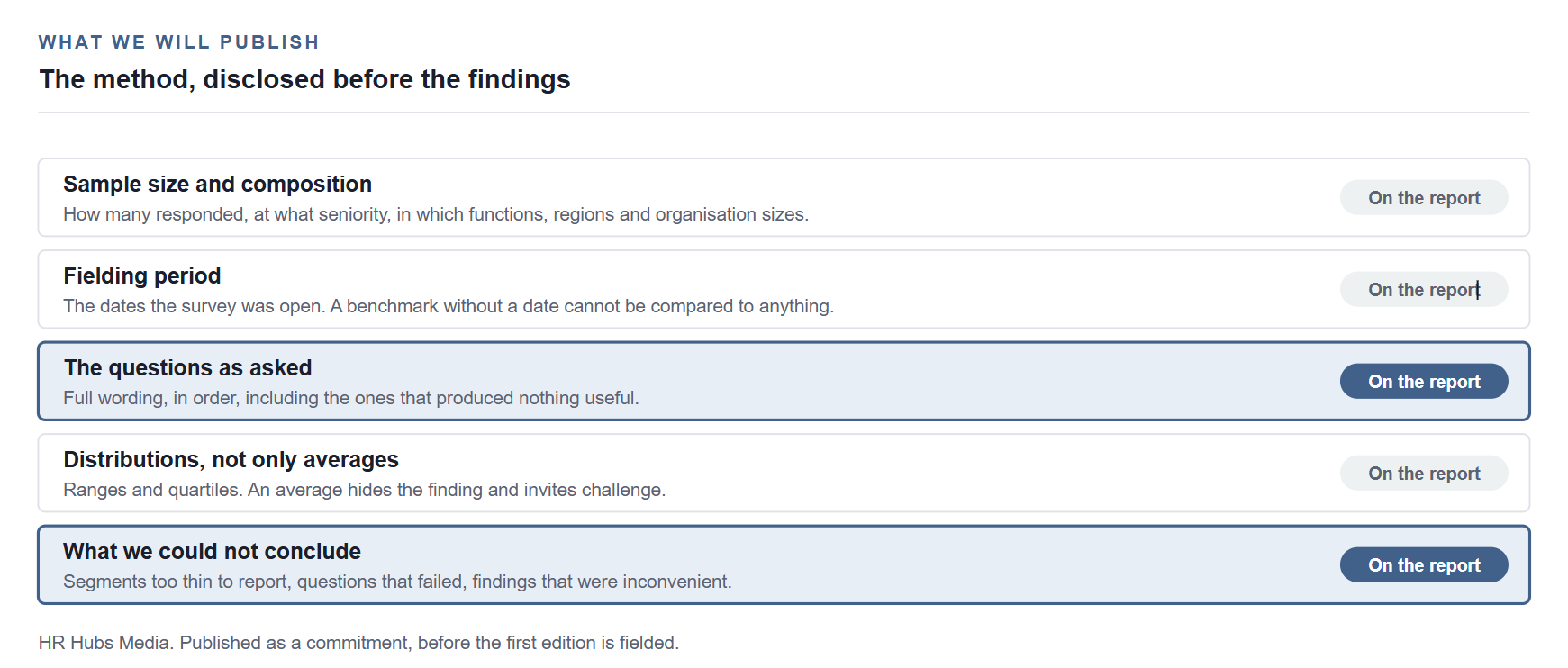
Every element below will appear on the report itself. A benchmark that publishes findings without them is asking to be trusted rather than checked.
This article does not contain survey findings. The survey has not been run. What follows is the specification, published before the research rather than after it.
We are doing it this way for a reason that emerged while preparing this publication's launch coverage. Across HR technology, and across the adjacent categories our sister titles cover, the same pattern recurs: benchmark figures circulate widely, are quoted confidently, and cannot be traced to a sample size, a fielding period or a method. Several of the most-repeated statistics in workplace technology turn out on inspection to be a remark made once, at a conference, more than a decade ago.
A publication that intends to document that problem has an obligation to not reproduce it.
What the Index will ask
Adoption. Which categories of HR technology are in production, which are in pilot, and which have been evaluated and rejected. The rejection question is the one most surveys omit and the one most useful to a reader, because knowing what peers tried and abandoned is worth more than knowing what they bought.
Budgets. Direction of travel for HR technology spend, the split between core systems and point solutions, and the proportion of the budget consumed by maintenance and integration rather than by new capability. That last figure is rarely reported and it explains most of why HR technology roadmaps move slowly.
Priorities. What HR leadership intends to change in the next twelve months, ranked, with the constraint that respondents must rank rather than select all that apply. Multi-select priority questions produce lists in which everything is a priority, which is how they are usually asked and why the results are useless.
AI in HR. Where it is deployed, sorted by whether it makes decisions about individuals. Governance in place, or not. Whether anyone has measured the override rate on systems that produce recommendations.
The workforce planning prerequisites. Whether the organisation holds position data, segmented attrition and internal movement history. We expect a substantial number to say no, and if that is what the data shows, that is what we will publish.
Data governance. Whether a retention schedule exists, whether data flows have been mapped, and whether the organisation could answer a subject access request from an employee within the required period without a special project.
What we will disclose
Sample size, and composition by seniority, function, region and organisation size.
The fielding period, as dates.
The questions as asked, in full and in order.
Distributions and ranges, not only averages.
Segments too thin to report, named as such rather than quietly merged.
Findings that are inconvenient for us, for our sponsors, or for the categories we cover.
The response rate, and what we know about who did not respond.
If a segment is too small to report, we will say so rather than report it. A benchmark that never encounters a segment too thin to publish is a benchmark that is not checking.
What is already missing from the published record
Preparing this specification meant looking for what already exists. Several questions HR leaders ask routinely have no credible published answer that we could find.
Whether engagement platforms change engagement. No controlled study. Extensive correlational material published by the vendors.
What proportion of discretionary learning content is completed. No benchmark separating mandated from discretionary content, which makes the aggregate figures unusable.
Whether enablement or onboarding programme design shortens ramp. No source publishes programme design against measured outcome.
What HR technology implementations actually cost, against budget. Widely discussed privately, never published.
How often automated recommendations in hiring are overruled. The single most important governance number in the category, and no organisation publishes it.
We will not answer all of those in one edition. We will answer some of them, and we will say plainly which ones we did not reach.
When
The Index will field once a year. The first edition will publish with the method attached, and every subsequent edition will report against the previous one on the same questions, worded identically, so the comparison means something.
Where we change a question we will say so and we will not present the two years as a trend.
An open invitation. If you would like to receive the questionnaire when it fields, or you think one of the questions above is the wrong one, write to us. The specification is published in advance precisely so that it can be argued with before it becomes a number people quote.
This article sets out a research specification. It contains no survey findings, because the survey has not been fielded.
References
Every figure and legal citation in this article is drawn from the sources below. Where an instrument is proposed rather than in force we say so in the text.
European Union, Regulation (EU) 2024/1689, the AI Act, Annex III on employment and worker management, referenced in the AI governance questions. https://artificialintelligenceact.eu/annex/3/
European Union, Regulation (EU) 2016/679, the GDPR, referenced in the data governance questions. https://eur-lex.europa.eu/eli/reg/2016/679/oj
Government of India, The Digital Personal Data Protection Act, 2023. https://www.meity.gov.in/data-protection-framework
How we work. This article was researched and written by the HR Hubs Media editorial team. We do not republish press releases. Every number and legal citation is checked against a primary source, which is named and linked above. Where an instrument is proposed rather than in force, we say so. Corrections are made openly on the article itself, never by silent edit. If you believe something here is wrong, write to info@hrhubsmedia.com and tell us what and why.
Filed under Core HR (HCM / HRIS) · Get The Weekly Brief