
Most organisations announcing a skills-based approach have changed their language. Far fewer have changed the machinery it depends on.
/
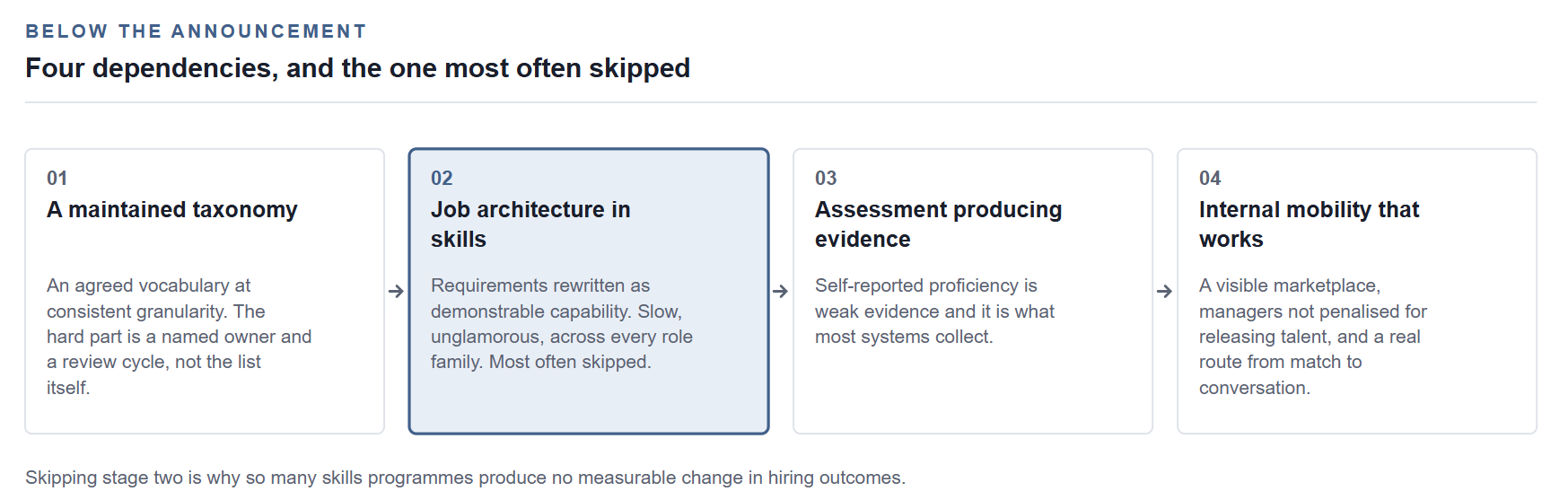
Announcing a skills-based approach is straightforward. Each of these has to be built for it to change who actually gets hired.
Skills-based hiring is a reasonable idea with a difficult implementation. The idea is that roles should be filled on demonstrated capability rather than on credentials and job-title history. The difficulty is that almost every system an organisation uses to manage people is built around job titles and credentials.
Announcing the shift is straightforward. Making it operate requires changing four things that sit well below the announcement.
A taxonomy somebody maintains
A skills approach requires an agreed vocabulary of skills, at a consistent level of granularity, that means the same thing across the organisation. Without it, one team records project management, another records agile delivery and a third records scrum, and no system can reconcile them.
The harder part is not creating the taxonomy, which vendors will supply. It is ownership. Skills vocabularies decay quickly as work changes, and one without a named owner and a review cycle is a snapshot that becomes misleading within a couple of years.
Job architecture rewritten in skills
If roles are still defined by years of experience and required degrees, sourcing and screening will continue to select on those attributes regardless of stated policy.
Rewriting requirements in terms of demonstrable capability is slow, unglamorous work across every role family, and it is the step organisations most often skip. Skipping it is why so many skills programmes produce no measurable change in who gets hired.
Assessment that produces evidence
Selecting on skills requires a way to establish that a candidate has them. Self-reported proficiency is weak evidence, and it is what most systems collect.
Work samples, structured exercises and validated assessments produce better evidence at greater cost in candidate time and administration. That trade-off is real and should be decided deliberately rather than defaulted.
There is a governance dimension here that is easy to miss. An assessment that produces a score used to filter candidates is an automated decision tool, and it attracts the same questions as any other: what does it infer, from what, and can a rejection be explained. A skills programme that replaces a credential filter with an unexamined algorithmic filter has moved the problem rather than solved it.
Internal mobility that actually functions
The strongest argument for a skills approach is internal: existing employees have capabilities their job titles do not capture. Realising that value requires an internal marketplace people can see, managers who are not penalised for releasing talent, and a genuine route from a skills match to a conversation.
The last of those is where most internal marketplaces fail. If an employee expresses interest and nothing happens twice, participation collapses and does not recover easily.
The manager incentive is the whole system. If releasing a strong performer to another team costs a manager headcount they cannot replace, no marketplace design will overcome it.
How to tell whether it is real
One test cuts through the language. Look at the last twenty hires. How many would have been screened out by the previous requirements?
If the answer is none, the change has happened in the careers page rather than in the process.
The measure worth tracking from the outset: the proportion of roles filled by candidates who would not have met the previous stated requirements. Record the previous requirements before you change them, or the measurement becomes impossible within a quarter.
This is reporting on workplace technology and operations. It is not legal, employment or procurement advice.
References
Every figure and legal citation in this article is drawn from the sources below. Where an instrument is proposed rather than in force we say so in the text.
European Union, Regulation (EU) 2024/1689, the AI Act, Annex III, on AI used in employment and worker management. https://artificialintelligenceact.eu/annex/3/
How we work. This article was researched and written by the HR Hubs Media editorial team. We do not republish press releases. Every number and legal citation is checked against a primary source, which is named and linked above. Where an instrument is proposed rather than in force, we say so. Corrections are made openly on the article itself, never by silent edit. If you believe something here is wrong, write to info@hrhubsmedia.com and tell us what and why.
Filed under Learning, Development & Skills · Get The Weekly Brief