
Catalogue size is the metric vendors lead with and the one that predicts nothing. Completion is harder to sell and it is the only thing that matters.
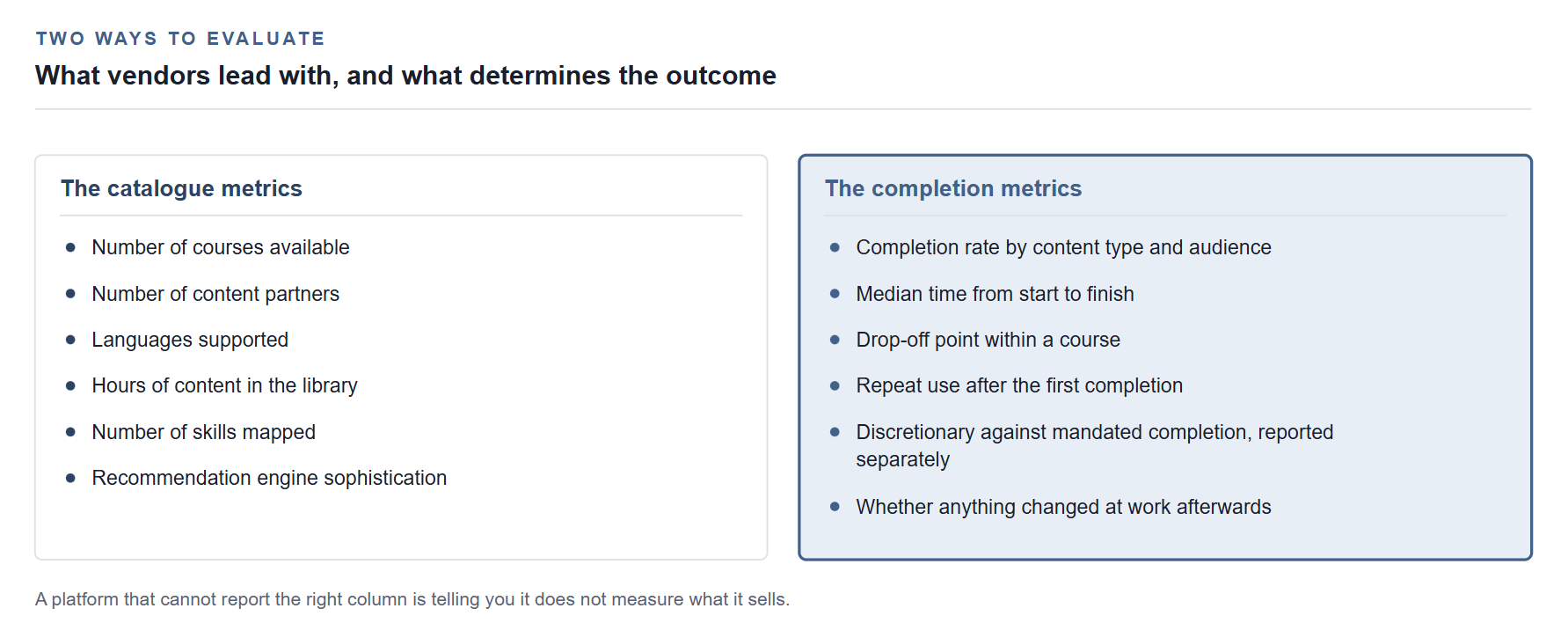
Almost every learning platform evaluation scores the left column. The right column is what determines whether anyone learns anything.
Learning platforms are sold on catalogue. Tens of thousands of courses, dozens of content partners, a recommendation engine to navigate it all.
Catalogue size predicts nothing about whether an organisation's people learn anything. Beyond a fairly low threshold it may work against it, because the primary experience becomes selection rather than learning, and selection is effortful in a way that reliably suppresses starting.
Why completion is the honest metric
Completion is not a perfect measure of learning. Somebody can finish a course and retain nothing. But it is the only widely instrumented measure that requires the learner to have done something, and its failures are informative in a way that catalogue metrics are not.
A low completion rate tells you something real: the content was too long, the moment was wrong, the relevance was unclear, or the learner was interrupted and never returned. Each of those is actionable. A large catalogue tells you nothing at all.
Ask every vendor for their completion rate distribution across their customer base, not their average. The average is carried by mandatory compliance training and hides everything interesting.
The distinction that has to be made
Compliance learning and discretionary learning behave completely differently and should never be reported together.
Compliance completion approaches one hundred per cent because it is required, tracked and escalated. It measures administrative follow-through, not learning, and including it in a headline completion figure makes the figure meaningless.
Discretionary completion is the number that reflects whether people find the content worth finishing. It is much lower and it is the one to optimise. Any platform that cannot separate the two in reporting is not a platform you can manage with.
What actually drives completion
Length, more than anything. Completion falls sharply with duration, and the effect is far larger than content quality effects. Shorter modules with a clear stopping point outperform longer ones on completion by a wide margin.
Proximity to the moment of need. Learning attached to a task the person is about to perform completes at a different rate from learning scheduled in advance. This is the strongest argument for embedding learning in the tools where work happens rather than in a destination people must visit.
Whether a manager knows. Discretionary learning that a manager is aware of and has made space for completes. Learning done in gaps that do not exist does not.
Whether it resumes cleanly. Most learning is interrupted. A platform that returns the learner to exactly where they stopped, across devices, recovers completions that are otherwise lost permanently.
Eleven questions
Can you report completion separately for mandated and discretionary content?
What is the completion rate distribution across your customer base, not the average?
Can you show drop-off within a course, at what point?
What is the median elapsed time from start to completion?
How does the learner resume an interrupted module, and across devices?
Where does learning appear in the flow of work, if at all?
What does the manager see, and what are they prompted to do?
Can we report on repeat use after a first completion?
How is content retired, and who decides? Libraries that only grow become unusable.
What data do we own and can we extract if we leave?
If skills mapping is included, who maintains the taxonomy and on what cycle?
How to run the evaluation
Take three real learning needs your organisation has now, and ask each vendor to show the path from a person having that need to that person having finished something useful. Time it. Count the clicks.
Then ask for a reference customer of similar size and ask them one question: what proportion of your discretionary learning gets finished, and how do you know.
Deliberately absent. We have not published industry completion benchmarks. We could not find any with a named publisher, a sample size and a stated definition separating mandated from discretionary content, and a number without that separation would mislead more than it informed. Your own baseline, measured before deployment, is the comparison that matters.
This is reporting on workplace technology and operations. It is not legal, employment or procurement advice.
References
Every figure and legal citation in this article is drawn from the sources below. Where an instrument is proposed rather than in force we say so in the text.
European Union, Regulation (EU) 2024/1689, the AI Act, Annex III, where learning systems feed worker-management decisions. https://artificialintelligenceact.eu/annex/3/
European Union, Regulation (EU) 2016/679, the GDPR, on processing learning and performance data about employees. https://eur-lex.europa.eu/eli/reg/2016/679/oj
How we work. This article was researched and written by the HR Hubs Media editorial team. We do not republish press releases. Every number and legal citation is checked against a primary source, which is named and linked above. Where an instrument is proposed rather than in force, we say so. Corrections are made openly on the article itself, never by silent edit. If you believe something here is wrong, write to info@hrhubsmedia.com and tell us what and why.
Filed under Learning, Development & Skills · Get The Weekly Brief