
Feature lists tell you what a platform can do. The buying question is which decisions you are delegating, and at which stage a human stops seeing every candidate.
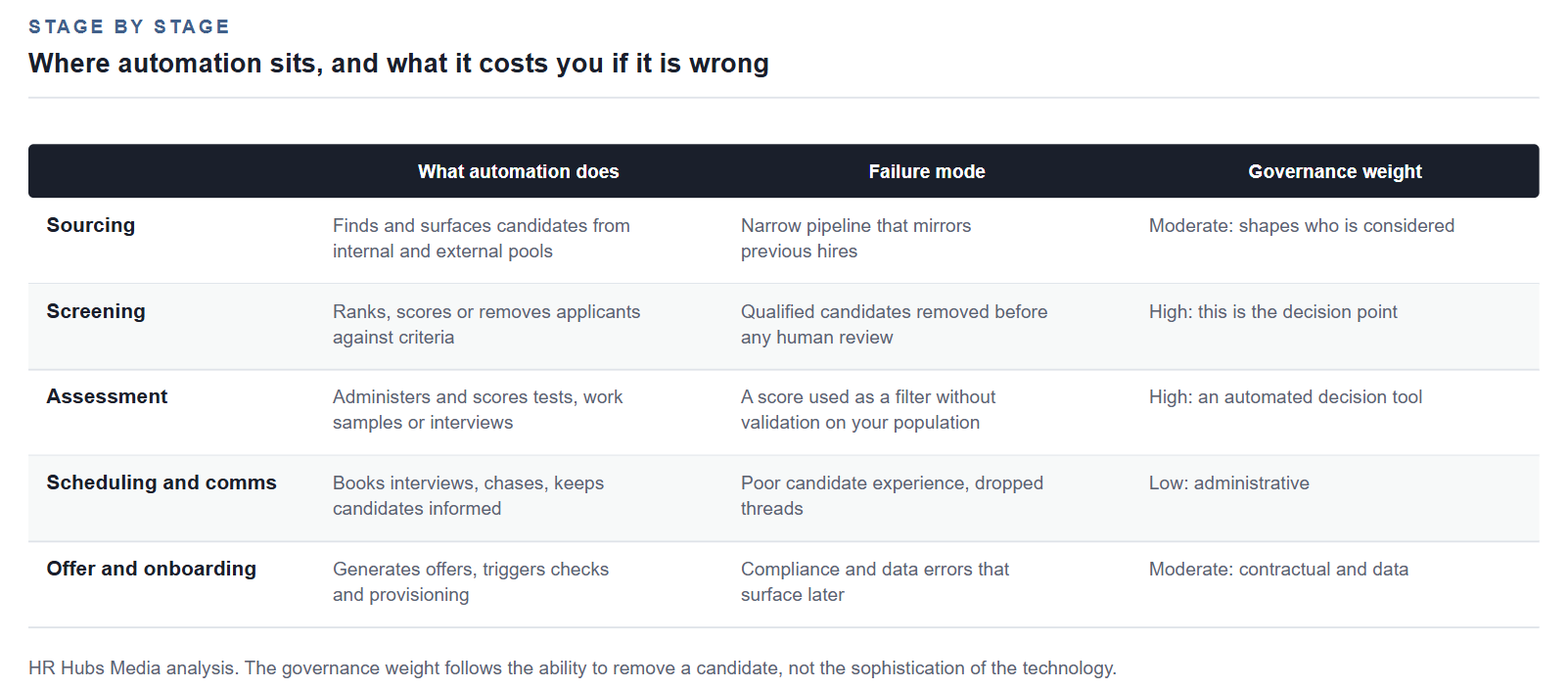
The hiring stages a platform may automate, what a failure looks like at each, and the governance weight the stage carries. The weight rises sharply once a candidate can be removed without a human seeing them.
Recruiting platforms are compared on features: sourcing reach, CRM depth, interview scheduling, analytics, integrations. Those matter for whether a team enjoys using the product. They do not answer the question a buyer should be asking, which is simpler and harder.
Which decisions am I delegating, and at which point does a human stop seeing every candidate?
The five stages, and where the weight is
Sourcing. The system finds candidates. This shapes who is considered without removing anyone, so the governance weight is moderate. The failure mode is a pipeline that mirrors previous hires, which is precisely the outcome a broadening strategy is trying to avoid, and it is invisible unless someone compares the sourced population against the addressable one.
Screening. The system ranks, scores or removes applicants. This is the decision point, and it is where almost all of the regulatory attention sits. The question to put to a vendor is not whether the product can filter, but whether the configuration you are buying will filter, at what threshold, and whether any human sees the excluded set.
Assessment. The system administers and scores. A score used to filter is an automated decision tool regardless of what the product is called, and it carries the same obligations.
Scheduling and communications. Administrative, low weight, and where most of the uncontroversial value sits. Automating chase emails and interview logistics reduces time to hire without deciding anything about a person.
Offer and onboarding. Contractual and data-heavy. Errors here surface months later as payroll, right-to-work or data protection problems rather than as hiring problems.
The governance weight follows the ability to remove a candidate, not the sophistication of the technology. A simple keyword filter that rejects applications is a heavier obligation than a sophisticated model that only ranks.
The regulatory frame worth understanding
The clearest published position is the European Union's. Annex III of Regulation (EU) 2024/1689, the AI Act, classifies AI systems used in employment and worker management as high risk. Those obligations apply from 2 August 2026.
High-risk classification is not a prohibition. It is an evidence regime: risk management, data governance, technical documentation, logging for traceability, information to the deployer, human oversight, accuracy and robustness, post-market monitoring. Almost every one of those obligations is discharged through records rather than through product features, which means the question to ask a vendor is what it will give you, not what it will do.
Note that the obligations fall on the deployer as well as the provider. Buying a compliant product does not make a deployment compliant.
Eight questions that establish what you are buying
At which stages can this product remove a candidate from consideration? Not rank. Remove.
In our configuration, will it? Get the answer about the configuration you are buying, not the product's capabilities.
Who sees the excluded set, and how? If nobody can inspect it, nobody can audit it.
What does the product log, and for how long? Which inputs drove which outcome, retained long enough to answer a complaint.
What can it produce for a candidate who asks why they were rejected? Ask to see an actual output, not a description of one.
What fairness testing has been done, on whose population? The vendor's testing was on the vendor's data.
Can we test on our own pipeline, at what interval, and who receives the result?
What documentation will you supply for our own records? Under an evidence regime, this is the deliverable.
How to run the evaluation
Draw your hiring process as it actually runs, stage by stage, and mark where the product would sit. Then mark, honestly, where a human currently sees every candidate and where they would stop.
That single diagram will tell you more about the risk you are taking on than any feature matrix, and it is the document you will want when somebody asks how the process works.
What we have not published here. We have not ranked named products. Vendor capabilities in this category change quarterly, configurations differ more than products do, and a ranking would date faster than it could be useful. The framework is the durable part.
This is reporting, not legal advice. Employment and data protection obligations differ significantly by jurisdiction and change frequently. Take qualified legal advice on your specific circumstances.
References
Every figure and legal citation in this article is drawn from the sources below. Where an instrument is proposed rather than in force we say so in the text.
European Union, Regulation (EU) 2024/1689, the AI Act, Annex III on employment and worker management. https://artificialintelligenceact.eu/annex/3/
European Commission, AI Act policy page, application dates and high-risk obligations, updated 27 July 2026. https://digital-strategy.ec.europa.eu/en/policies/regulatory-framework-ai
European Union, Regulation (EU) 2016/679, the GDPR, Article 22 on automated individual decision-making. https://eur-lex.europa.eu/eli/reg/2016/679/oj
How we work. This article was researched and written by the HR Hubs Media editorial team. We do not republish press releases. Every number and legal citation is checked against a primary source, which is named and linked above. Where an instrument is proposed rather than in force, we say so. Corrections are made openly on the article itself, never by silent edit. If you believe something here is wrong, write to info@hrhubsmedia.com and tell us what and why.
Filed under Talent Acquisition & Recruiting · Get The Weekly Brief