
This edition is short because we verify before we publish. What it does contain is the checklist to run the next time an acquisition lands in your inbox.
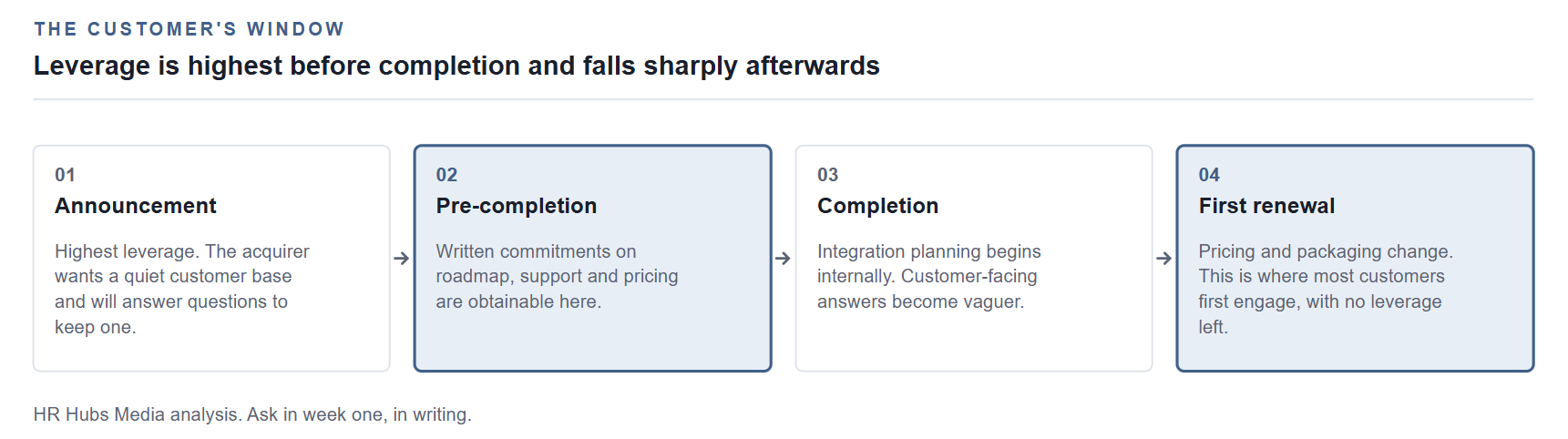
The period between announcement and completion is the only time a customer has both information and negotiating position. Most customers wait until renewal, by which point both have gone.
A recurring brief. We report funding rounds, acquisitions and leadership changes we can verify against a named source with a date, we say when a transaction is an agreement rather than a completion, and we lead with what it means for people who already use the product.
This edition, and why it is short
We were unable to verify any HR technology funding round, acquisition or senior leadership change from June or July 2026 to our standard, which is a named primary source carrying a date. That is a limitation of our verification this cycle rather than a claim that nothing happened.
We are telling you that rather than filling the space, because a brief that reports twelve unverified items and a brief that reports none look identical to a reader who cannot check, and only one of them is honest.
If you know of a transaction in this period, write to us and we will verify and publish it.
What to do when it does happen
Since consolidation in this category is continuous, the durable value of this brief is the checklist. Most HR teams learn their vendor has been acquired from a cheerful email and take no action until renewal. That is the wrong order.
The period between announcement and completion is the only time you have both information and leverage. The acquirer wants a quiet customer base through the transition and will answer questions in writing to secure one. After completion, integration planning moves inside and the answers get vaguer. By renewal, pricing and packaging have usually changed and you have nothing left to trade.
Ask in week one, ask in writing, and ask for a written answer. A verbal reassurance from an account manager who may not be in post in six months is not a commitment.
Eight questions to send in week one
Will this product continue to be sold and supported as a standalone? Ask for a period, not a sentiment.
What happens at our first renewal after completion? Pricing, packaging and minimum commitments. Get the answer before you need it.
Which integrations are committed for the next twenty-four months? Particularly integrations to the acquirer's competitors, which are the first to be deprioritised.
Who is our support contact after completion, and does the SLA change?
Where will our employee data be held, and does the sub-processor list change? An acquisition frequently changes both, and both usually require notification under your own agreements.
Does the data processing agreement survive unchanged, and who is the controller and processor after completion?
What is the exit position? Data extraction format, notice period, assistance on transition. Confirm it now rather than discovering it later.
Is there a change of control clause in our contract, and what does it entitle us to? Many customers have one and have never read it.
The pattern worth recognising
HR technology consolidation tends to follow a consistent shape. A platform vendor acquires a specialist to fill a gap. For the first year the acquired product is sold as before. In the second, it becomes a module of the platform, and the standalone version is quietly deprioritised: fewer releases, integrations to competing platforms maintained but not extended, and pricing that increasingly favours buying the suite.
For a customer already on the acquiring platform this is usually good news. For a customer who deliberately chose a best-of-breed product to sit alongside a different core system, it is the beginning of a migration decision that will arrive in about two years.
Neither outcome is a reason to panic at announcement. Both are reasons to get the answers in writing while somebody still wants to give them to you.
Our standard for this brief. Every item we publish names a source that is the company itself, a regulatory filing, or a named publication with a date. We do not report a round, an acquisition or an appointment from a roundup we cannot trace to a primary source. Where a roundup is the only source, we say it is single-sourced.
This is reporting on corporate events. It is not investment advice. Where a transaction is an agreement rather than a completion, we say so.
References
Every figure and legal citation in this article is drawn from the sources below. Where an instrument is proposed rather than in force we say so in the text.
European Union, Regulation (EU) 2016/679, the GDPR, on controller and processor roles and sub-processor changes. https://eur-lex.europa.eu/eli/reg/2016/679/oj
Government of India, The Digital Personal Data Protection Act, 2023, on data fiduciary obligations. https://www.meity.gov.in/data-protection-framework
European Commission, AI Act policy page, relevant where an acquired product is used in worker management, updated 27 July 2026. https://digital-strategy.ec.europa.eu/en/policies/regulatory-framework-ai
How we work. This article was researched and written by the HR Hubs Media editorial team. We do not republish press releases. Every number and legal citation is checked against a primary source, which is named and linked above. Where an instrument is proposed rather than in force, we say so. Corrections are made openly on the article itself, never by silent edit. If you believe something here is wrong, write to info@hrhubsmedia.com and tell us what and why.
Filed under Talent Acquisition & Recruiting · Get The Weekly Brief