
The value is in high-volume administrative work where a mistake is visible and reversible. The risk is in decisions about individuals. Those are different products sold by the same vendors.
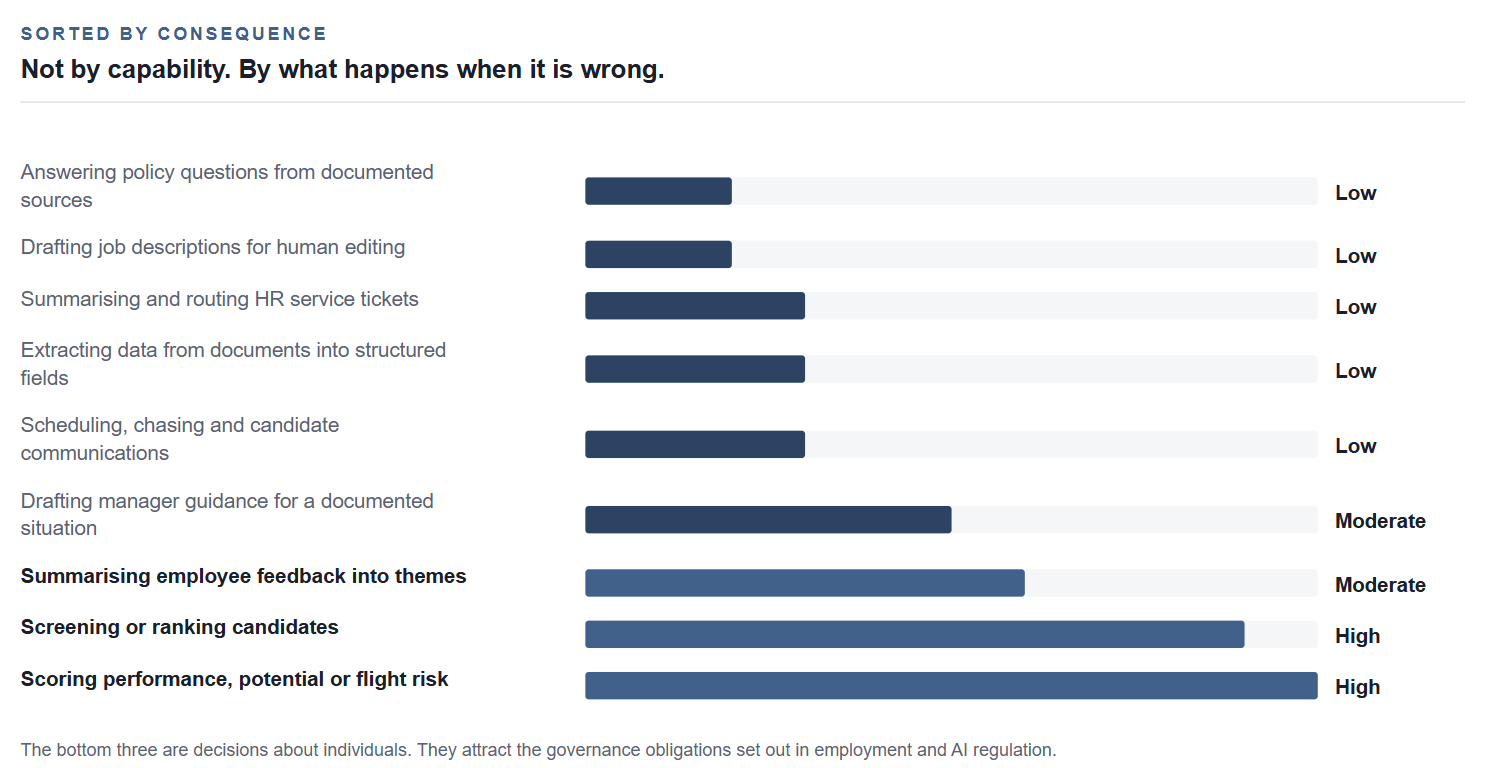
An assessment of common HR AI applications by the consequence of an error. The line to watch is where a mistake stops being an inconvenience and becomes a decision about a person's employment.
Most coverage of AI in HR sorts applications by capability: what the technology can do. That is the wrong axis for anyone actually responsible for deploying it.
The useful axis is consequence. What happens when it is wrong, who finds out, and can it be undone. Sorted that way, the picture becomes clear and considerably less exciting than the marketing, which is generally a good sign.
Where it genuinely works
The wins share three properties: high volume, low individual consequence, and an error that is visible and reversible.
Answering policy questions. An assistant grounded in the organisation's own documented policies, answering the questions HR service desks receive hundreds of times a month. The critical design decision is grounding: it must answer from the document set and say when it does not know, rather than generating a plausible answer. A wrong answer here is embarrassing and correctable. A confidently invented policy is not.
Ticket summarisation and routing. Reading an incoming request, categorising it, and sending it to the right queue with a summary attached. Misrouting is a delay, not a harm, and the human at the other end sees the original.
Document data extraction. Pulling structured fields out of unstructured documents during onboarding or case handling. Verifiable against the source document, which is the property that makes it safe.
Drafting. Job descriptions, policy first drafts, communications. A human edits before anything is used, and the time saved is real.
Scheduling and candidate communications. Genuine, unglamorous value. Nothing about a person is being decided.
Everything on that list has a human between the output and any consequence for an individual. That is not a coincidence, it is the defining property.
Where it becomes something else
Three applications cross the line, and they cross it whatever the product is called.
Screening or ranking candidates. Covered at length elsewhere in our coverage. If the system can remove a candidate, or produce a ranking that is rarely overruled, it is making a decision.
Scoring performance, potential or flight risk. The most consequential and the least examined. A flight-risk score that influences who gets development investment, or a potential rating that shapes succession, is a decision about a career made partly by a model. The individual usually does not know it exists.
Summarising employee feedback into themes. This one is included deliberately because it looks administrative and is not. If summarisation determines what leadership hears, the summariser is setting the agenda, and a systematic tendency to compress minority views into noise will not be visible in the output.
The regulatory position, briefly
Annex III of Regulation (EU) 2024/1689, the AI Act, classifies AI systems used in employment and worker management as high risk. Those obligations apply from 2 August 2026.
High-risk classification brings an evidence regime: risk management, data governance, technical documentation, logging, human oversight, accuracy, and post-market monitoring. Separately, where a decision about an individual is made solely by automated means and has legal or similarly significant effects, data protection law in the European Union and elsewhere imposes its own requirements.
The practical reading for an HR team is that the low-consequence list above is largely unaffected, and the high-consequence list is an evidence obligation you should be building for now regardless of the date.
Four controls that keep the first list from becoming the second
Ground everything in your own documents, and require abstention. A system that says it does not know is worth more than one that is usually right.
Keep a human between output and consequence, and measure the override rate. If nobody ever overrides, the human is decorative and the classification is wrong.
Log inputs and outputs from day one. Retrofitting an audit trail is not possible, and it is what every subsequent obligation depends on.
Re-check on your own population at a fixed interval. A system validated at deployment is not validated permanently, and drift is silent.
The pattern across every organisation getting real value from this is the same. They deployed into administrative volume, they kept people in the consequential decisions, and they can say precisely which category each tool is in.
This is reporting, not legal advice. Employment and data protection obligations differ significantly by jurisdiction and change frequently. Take qualified legal advice on your specific circumstances.
References
Every figure and legal citation in this article is drawn from the sources below. Where an instrument is proposed rather than in force we say so in the text.
European Union, Regulation (EU) 2024/1689, the AI Act, Annex III on employment and worker management. https://artificialintelligenceact.eu/annex/3/
European Union, Regulation (EU) 2016/679, the GDPR, Article 22 on automated individual decision-making. https://eur-lex.europa.eu/eli/reg/2016/679/oj
European Commission, AI Act policy page, application dates and high-risk obligations, updated 27 July 2026. https://digital-strategy.ec.europa.eu/en/policies/regulatory-framework-ai
How we work. This article was researched and written by the HR Hubs Media editorial team. We do not republish press releases. Every number and legal citation is checked against a primary source, which is named and linked above. Where an instrument is proposed rather than in force, we say so. Corrections are made openly on the article itself, never by silent edit. If you believe something here is wrong, write to info@hrhubsmedia.com and tell us what and why.
Filed under AI & Automation in HR · Get The Weekly Brief