
Workforce planning tools assume a level of data quality that almost nobody holds. The gap is not analytical capability. It is six specific inputs.
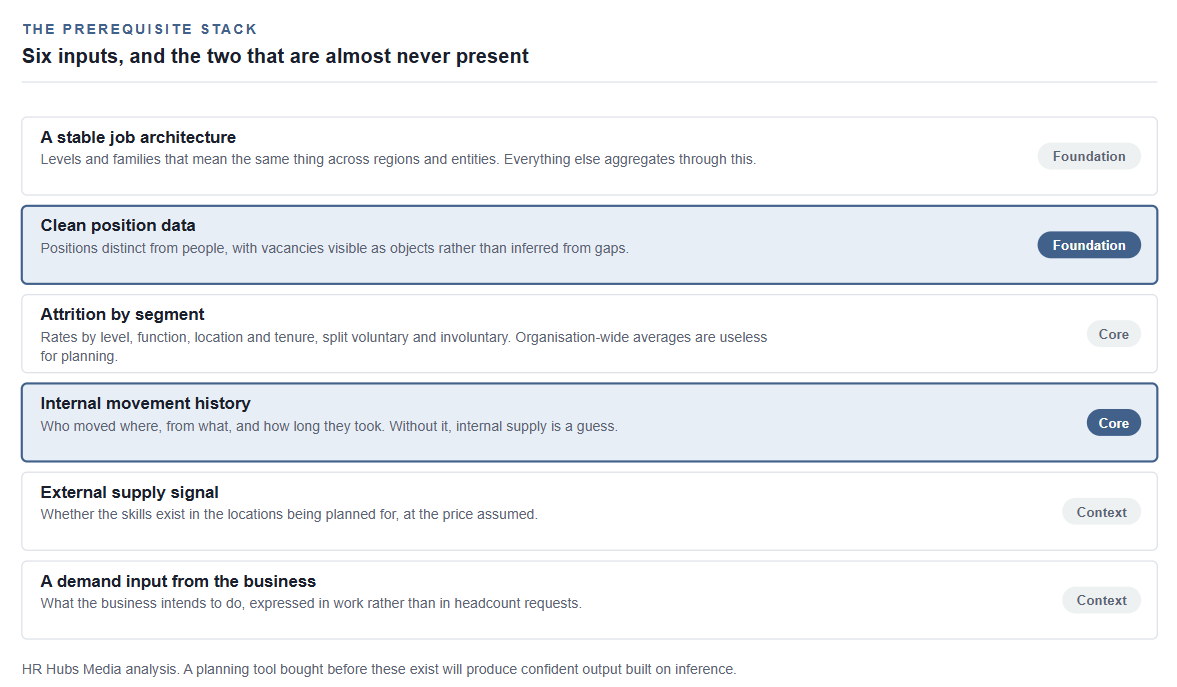
Planning tools operate on the top layer. The layers beneath determine whether the output means anything. The two marked are the ones we would expect to be missing most often.
Workforce planning software is usually bought to answer a question the organisation has been asking for years: how many people, of what kind, where, and when.
The software can answer it. Whether the answer means anything depends on six inputs, and in most organisations at least two of them do not exist in usable form. This is worth establishing before the purchase, because the tools are good at producing confident-looking output from inference.
1. A job architecture that holds
Every planning output aggregates through job structure. If levels were set regionally, inherited through acquisition, or used for recognition rather than classification, then a plan that says the organisation needs eleven more people at level four is describing something that does not mean the same thing in two different countries.
This is the same foundation that pay transparency, skills programmes and internal mobility all rest on, which is worth knowing when the business case is written. It is one investment supporting four initiatives, and it is usually funded by none of them.
2. Position data, distinct from people
Many HR systems record employees. Fewer record positions as objects that exist independently of whoever occupies them.
Without position management, a vacancy is inferred from a gap between an approved headcount number held somewhere in finance and a count of current employees. That inference breaks on every part-time arrangement, every long-term absence, every contractor covering a permanent role, and every position held open deliberately.
If your organisation cannot produce a list of open positions without a manual reconciliation against a finance spreadsheet, position data is the first thing to fix and no planning tool will compensate for it.
3. Attrition by segment, split by type
An organisation-wide attrition rate is close to useless for planning. What planning needs is rates by level, function, location and tenure band, split into voluntary and involuntary.
The split matters more than the rate. Voluntary attrition among high performers in a critical function is a different planning input, and a different management problem, from involuntary attrition following a restructure. Aggregated together they cancel out and the number reads as stable while the composition changes underneath.
The refinement worth adding, which very few organisations hold, is internal promotion counted separately from external exit. A person leaving a team for another team is a loss to that team and a gain to the organisation, and a system that records both as attrition will systematically over-forecast external hiring.
4. Internal movement history
Internal supply is the input planning is most often forced to guess at. Answering how many people could move into a role, from where, and how long the transition takes, requires a history of people actually having done so.
Most organisations hold job change records that show the destination and not the path. Reconstructing the path retrospectively is possible and laborious, and it is worth doing once because it establishes the base rates every subsequent plan will use.
5. External supply signal
A plan that assumes forty engineers can be hired in a specific city within two quarters at an assumed cost is making three claims about the external market. Labour market data of varying quality is available to test them, and the important discipline is to test them explicitly rather than embed them silently.
Where the data is weak, say so in the plan. An assumption that is visible can be challenged. An assumption buried in a model cannot.
6. A demand input the business will stand behind
This is the least technical and the most decisive. Workforce planning requires the business to say what it intends to do, in terms of work rather than headcount.
The failure pattern is familiar: the business submits headcount requests, HR aggregates them, finance reduces them, and the result is called a workforce plan. That is a budgeting exercise. A plan starts from what the organisation is trying to produce and derives the people from it, which requires a conversation most operating models do not have a forum for.
Where to start
Test job architecture consistency across two regions before anything else. Take one role family and compare it.
Establish whether positions exist as objects. If not, fix that before evaluating tools.
Rebuild attrition by segment, splitting voluntary, involuntary and internal movement. Do it for two years so you have a trend.
Reconstruct internal movement paths once, manually if necessary, to establish base rates.
Write assumptions about external supply into the plan as named assumptions, not as inputs.
Agree with the business how demand will be expressed, before the first planning cycle rather than during it.
None of this requires software. All of it determines whether software will help.
This is reporting on workplace technology and operations. It is not legal, employment or procurement advice.
References
Every figure and legal citation in this article is drawn from the sources below. Where an instrument is proposed rather than in force we say so in the text.
European Union, Regulation (EU) 2016/679, the GDPR, on processing employee personal data for analytics purposes. https://eur-lex.europa.eu/eli/reg/2016/679/oj
Government of India, The Digital Personal Data Protection Act, 2023. https://www.meity.gov.in/data-protection-framework
How we work. This article was researched and written by the HR Hubs Media editorial team. We do not republish press releases. Every number and legal citation is checked against a primary source, which is named and linked above. Where an instrument is proposed rather than in force, we say so. Corrections are made openly on the article itself, never by silent edit. If you believe something here is wrong, write to info@hrhubsmedia.com and tell us what and why.
Filed under People Analytics & Workforce Planning · Get The Weekly Brief