
The obligations are usually described as disclosure requirements. Operationally they are data requirements, and most HR systems were not built to hold the data.
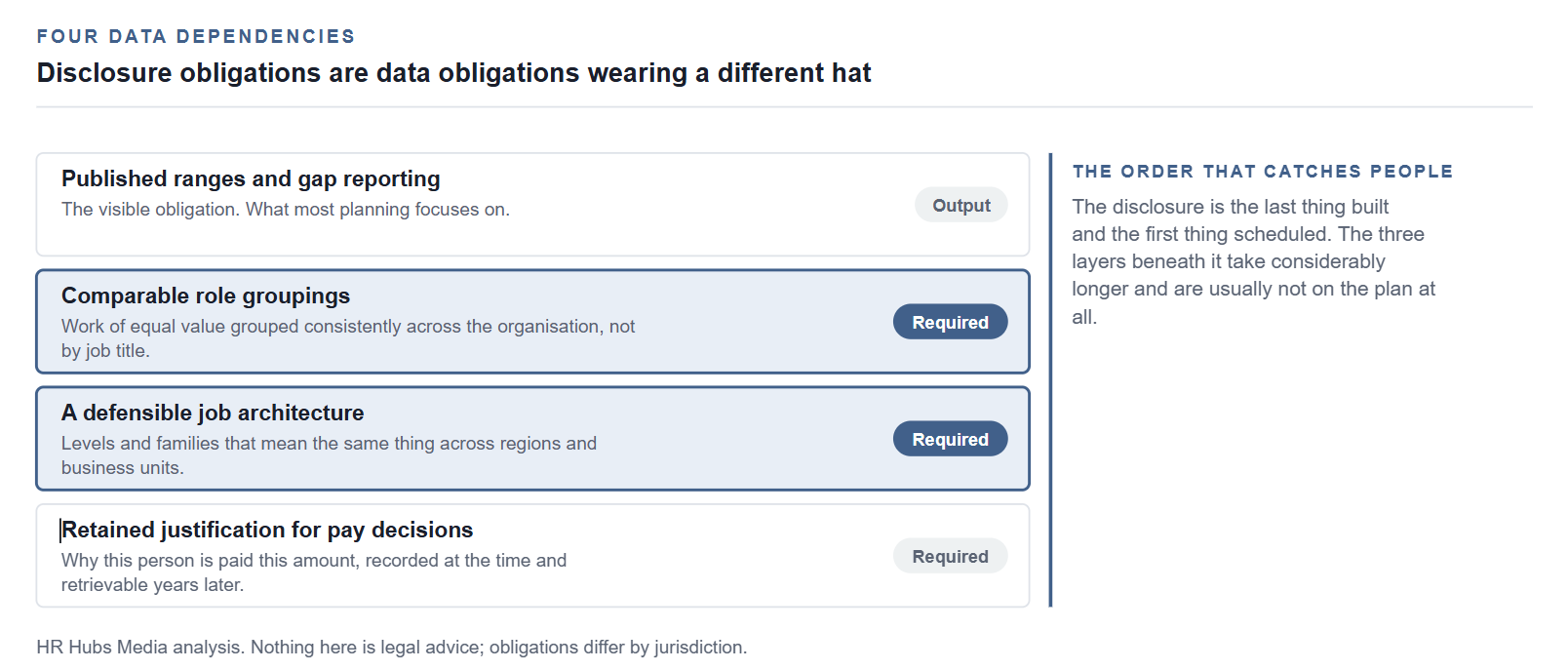
Each layer has to exist before the disclosure at the top can be produced reliably. Organisations usually discover the gap at the point of first reporting.
Pay transparency is discussed as a disclosure question: what has to be published, to whom, and when. That framing is accurate about the obligation and misleading about the work.
Publishing a number is trivial. Producing a number you can stand behind, defend under challenge, and reproduce consistently next year is a data problem, and it reaches considerably further into HR systems than most implementation plans assume.
What the obligations have in common
Jurisdictions differ substantially in what they require and we are not going to summarise any of them as though they were interchangeable. Take advice on the ones that apply to you. But the family of obligations now emerging across the European Union, several United States states and elsewhere tends to draw on the same underlying capabilities.
Disclosure of a pay range for an advertised role, at a defined point in the process.
Restrictions on asking candidates about pay history.
A right for employees to obtain information about pay levels for work of equal value.
Reporting of pay differences between groups, sometimes with a threshold above which a joint assessment or remedial action is triggered.
Retention of the reasoning behind pay decisions, sufficient to answer a challenge.
Each of those depends on something the organisation must already hold.
1. A job architecture that means the same thing everywhere
Every one of these obligations rests on the idea that two roles are comparable. If your levels were set regionally, or inherited through acquisition, or drifted as titles were used for recognition rather than classification, comparability does not exist in the data.
This is the longest lead-time item and it is rarely on the pay transparency plan, because it does not look like a pay transparency task. It is the pay transparency task.
2. Groupings for work of equal value
Equal value is not the same as equal title. Grouping roles of comparable value across different functions is a judgement, and it has to be made consistently, documented, and applied the same way next year.
An organisation that produces one set of groupings for its first report and a different set for its second has created a problem rather than met an obligation.
3. Retained justification for pay decisions
The obligation that most often catches organisations out is the requirement to explain a difference. That explanation is made at the moment of the decision, usually in a conversation, and it is almost never recorded in a way that survives.
Systems typically hold what someone is paid and when it changed. They rarely hold why. Adding a structured, mandatory reason at the point of any pay decision is a small configuration change with a very long payback, and it cannot be applied retrospectively.
You cannot reconstruct in 2028 the reasoning behind a 2024 pay decision. Either it was recorded at the time or the answer to a challenge is that nobody knows.
4. Reporting that reconciles to payroll
Gap reporting drawn from the HR system and pay drawn from the payroll system will disagree, because they treat allowances, bonuses, part-time equivalence and mid-period joiners differently.
Decide which system is authoritative for reporting, document the treatment of every pay element, and reconcile before the first submission rather than after a query.
A practical sequence
Establish whether your job architecture is genuinely consistent across regions and entities. Assume it is not until tested.
Add a mandatory structured reason field to every pay change now, whatever your reporting deadline. This one is urgent because it only works prospectively.
Agree and document the equal-value groupings, and record who approved them.
Reconcile HR and payroll definitions for every pay element before you report anything.
Run the report privately a year early. The first run is diagnostic, and you want the surprises in a room rather than in a publication.
Decide the internal communications position before the external one. Employees will read the published figures and ask about their own pay, and that conversation is the actual event.
Deliberately not summarised here. We have not set out the specific requirements or dates of any individual jurisdiction's rules. They differ substantially, they are changing, and a summary accurate in one country would be misleading in another. Take qualified advice for each jurisdiction you employ in, and use this piece for the systems work, which is common to all of them.
This is reporting, not legal advice. Employment and data protection obligations differ significantly by jurisdiction and change frequently. Take qualified legal advice on your specific circumstances.
References
Every figure and legal citation in this article is drawn from the sources below. Where an instrument is proposed rather than in force we say so in the text.
European Union, Regulation (EU) 2016/679, the GDPR, on lawful processing of employee personal data including pay data. https://eur-lex.europa.eu/eli/reg/2016/679/oj
European Union, Regulation (EU) 2024/1689, the AI Act, Annex III, where pay or promotion decisions are automated. https://artificialintelligenceact.eu/annex/3/
Government of India, The Digital Personal Data Protection Act, 2023, on processing personal data of employees. https://www.meity.gov.in/data-protection-framework
How we work. This article was researched and written by the HR Hubs Media editorial team. We do not republish press releases. Every number and legal citation is checked against a primary source, which is named and linked above. Where an instrument is proposed rather than in force, we say so. Corrections are made openly on the article itself, never by silent edit. If you believe something here is wrong, write to info@hrhubsmedia.com and tell us what and why.
Filed under Payroll & Compensation · Get The Weekly Brief