
Four structures are sold under similar language. They differ in who the legal employer is, and that difference determines who answers for everything else.
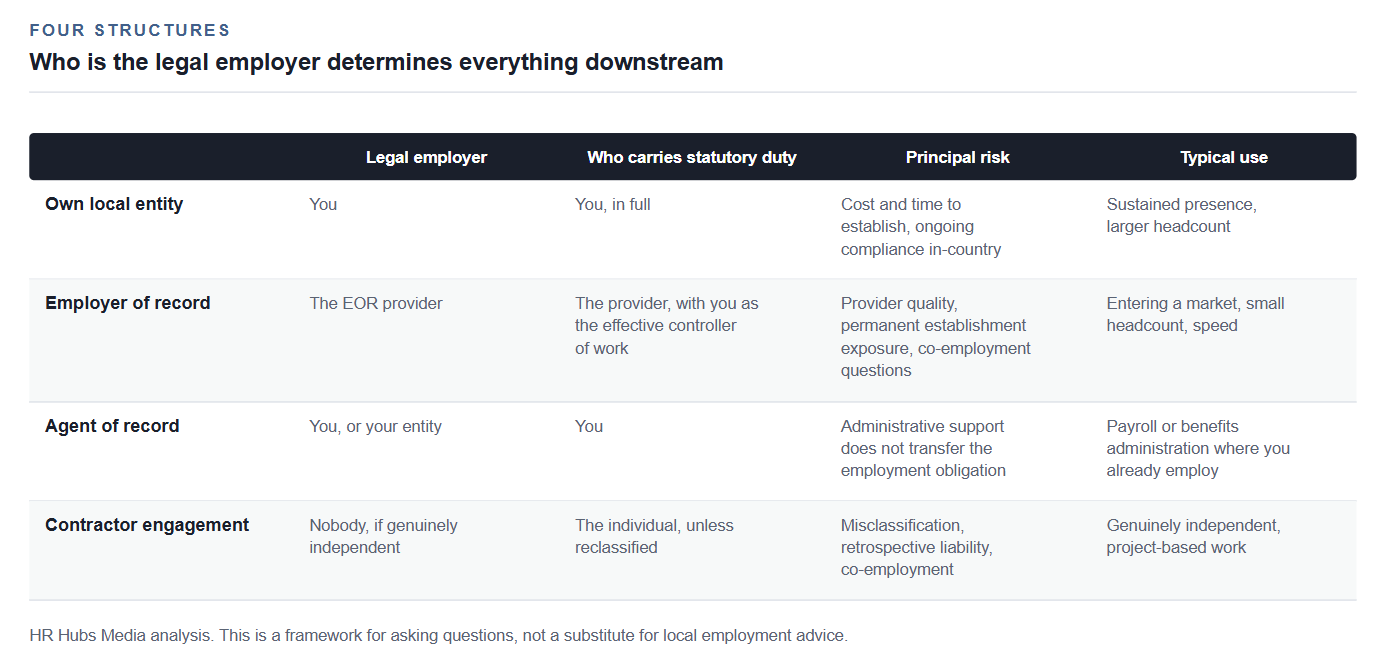
The models are marketed in similar language and differ fundamentally. Contractual indemnities allocate cost between the parties; they do not move the employment relationship.
Global employment providers are sold on a common promise: hire anyone, anywhere, in days, without setting up an entity. The promise is broadly deliverable. What differs, and what determines your exposure, is which of four structures you are actually buying.
They are frequently described in overlapping language, and one of them is routinely mistaken for another in a way that carries real consequences.
The four structures
Your own local entity. You establish a legal presence, you are the employer, you carry every statutory obligation directly. Slowest and most expensive to set up, and the only structure with no intermediary. For sustained presence at scale it usually becomes the right answer, and the question is when to transition rather than whether.
Employer of record. A provider with a local entity becomes the legal employer of the individual. They run payroll, withhold and remit, provide statutory benefits and hold the employment contract. You direct the work. This is the structure most often meant when people say EOR, and it is genuinely useful for entering a market quickly or employing a small number of people where an entity is not justified.
Agent of record. An administrative arrangement in which a provider handles payroll, benefits or filings on your behalf. You remain the employer. This is the one most often confused with an employer of record, and the confusion matters because the employment obligation has not moved anywhere. Administrative support is not a transfer of duty.
Contractor engagement. The individual is genuinely independent and there is no employment relationship. This is a legitimate structure for genuinely independent work and it is also the most commonly misused, because it is the cheapest and the easiest to start.
The recurring error is treating an administrative arrangement as though it transferred employment status. If a provider is not the legal employer in that jurisdiction, nothing about your obligations has changed no matter what the service is called.
Where the risk actually sits
Misclassification. The dominant risk in contractor engagement, and it is assessed on substance rather than on the contract. Control over how and when work is done, integration into the organisation, exclusivity, provision of equipment and duration all point toward employment regardless of what the parties agreed. Reclassification is typically retrospective, and it brings unpaid contributions, benefits, and sometimes penalties with it.
Permanent establishment. Employing people in a country through an intermediary does not automatically create a taxable presence, and certain activities can. An employee concluding contracts, or performing core business functions rather than auxiliary ones, changes the analysis. This is a tax question with an HR trigger, and the two functions frequently do not talk until a filing is due.
Provider quality. In an employer of record arrangement you have transferred the employment relationship to a company whose local compliance you cannot see. If they fail to remit contributions, the employee's position is affected and so is yours. Provider due diligence is the control that substitutes for the visibility you have given up.
Co-employment questions. Where you direct the work closely and the provider is the legal employer, some jurisdictions will look at the substance of the relationship. Being clear about who instructs, who appraises, who disciplines and who terminates is part of the design, not an afterthought.
Transition. The exposure organisations plan for least. When headcount in a country justifies your own entity, the people have to move employer. That is a transfer of employment with its own rules in most jurisdictions, and the terms on which it can happen should be agreed at the start rather than negotiated when you want to leave.
Questions to establish what you are buying
In this jurisdiction, who is the legal employer named on the contract? Ask for the entity name and confirm it is registered locally.
Is the provider employing through their own entity or through a partner? A chain of subcontracted entities is common and rarely disclosed unprompted.
What happens if the provider fails to remit contributions? Get the answer in the contract, not in the meeting.
Who instructs, appraises, disciplines and terminates? Write it down. Substance beats labels.
What are the transition terms if we establish our own entity? Agree this before signing, not before leaving.
What is the notice, severance and statutory benefit position in each country? It differs enormously and it is your cost.
Where does data about these employees sit, and under which law? The employment structure and the data structure are separate questions.
Two of those, the legal employer's identity and the transition terms, will tell you most of what you need to know. Providers who answer both directly are usually the ones who have thought about the rest.
This is reporting, not legal advice. Employment and data protection obligations differ significantly by jurisdiction and change frequently. Take qualified legal advice on your specific circumstances.
References
Every figure and legal citation in this article is drawn from the sources below. Where an instrument is proposed rather than in force we say so in the text.
European Union, Regulation (EU) 2016/679, the GDPR, on cross-border processing of employee data. https://eur-lex.europa.eu/eli/reg/2016/679/oj
Government of India, The Digital Personal Data Protection Act, 2023. https://www.meity.gov.in/data-protection-framework
How we work. This article was researched and written by the HR Hubs Media editorial team. We do not republish press releases. Every number and legal citation is checked against a primary source, which is named and linked above. Where an instrument is proposed rather than in force, we say so. Corrections are made openly on the article itself, never by silent edit. If you believe something here is wrong, write to info@hrhubsmedia.com and tell us what and why.
Filed under Workforce Management & Contingent · Get The Weekly Brief