
Nobody has published a controlled answer. What is published is a measurement instrument being sold as an intervention, and the distinction matters more than the score.
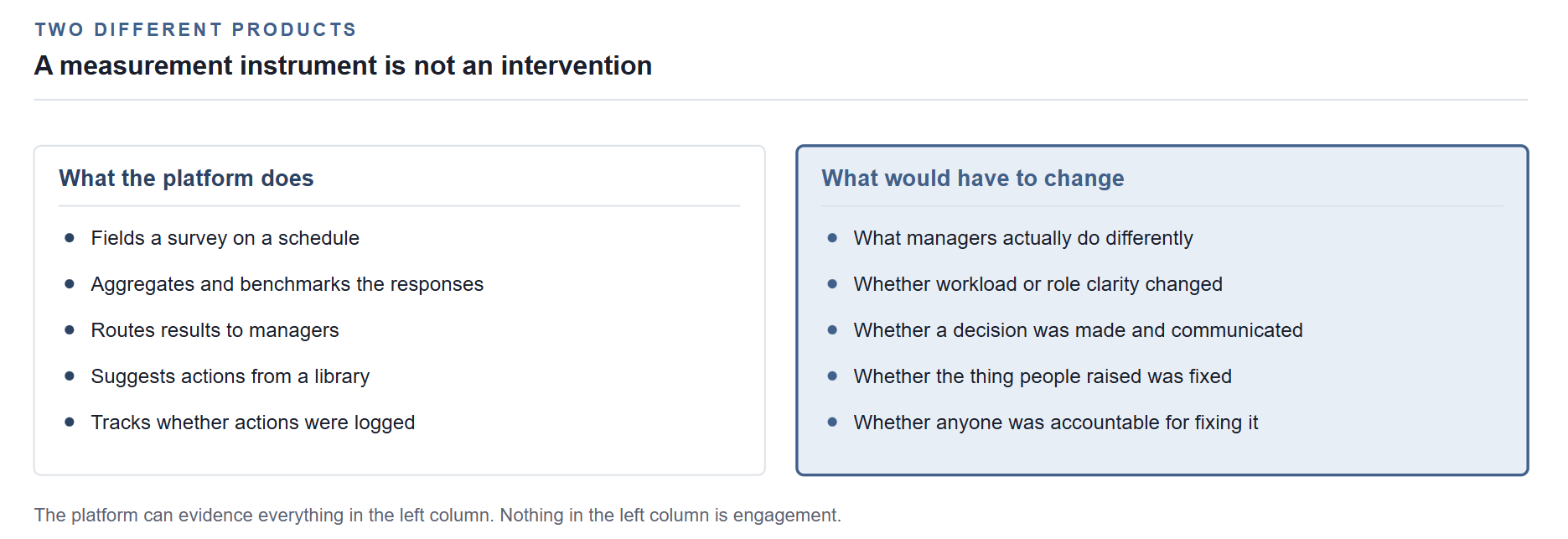
Engagement platforms are bought to do the second and evidenced on the first. The distinction determines what the score can tell you.
The engagement platform category rests on a chain of assumptions: measure engagement frequently, surface the results to managers, prompt action, and engagement improves. Each link is plausible. We went looking for evidence that the chain holds.
There is no controlled published study establishing that deploying an engagement platform changes engagement, and there is certainly none establishing that it changes anything downstream of engagement. What exists is a large body of correlational material published by the vendors, showing that organisations with higher engagement scores perform better on various measures.
That correlation is real and it is not the claim being bought. Organisations that score well on engagement differ from those that do not in many ways, of which owning a survey platform is unlikely to be the causal one.
What the category has instead of evidence
Benchmark databases. Vendors hold large panels of survey responses and can tell you how your score compares. That is genuinely useful for context and tells you nothing about whether their product moved your score.
Correlational outcome studies. Higher-engagement organisations show better retention, safety or productivity in the vendor's dataset. Almost always cross-sectional, self-selected, and unable to separate direction of causation.
Customer case studies. A named organisation improved a score after deployment. No control group, no account of what else changed in the same period, and a selection process that means you are seeing the successes.
Action-completion metrics. The share of managers who logged an action after seeing results. This measures use of the platform, not effect.
None of the four is a bad thing to publish. The problem is that together they are presented as an answer to a question none of them addresses.
The measurement problem underneath
There is a second difficulty that the category rarely acknowledges: the instrument affects the measurement.
Frequent surveying changes response behaviour. Response rates decay when people conclude nothing follows from responding. Employees adjust their answers when they believe results are visible to their manager at a granularity that identifies them. And an organisation under stress often sees participation fall before it sees scores fall, which means the score can improve while the underlying position deteriorates.
Any organisation reporting an improved score should check the participation trend in the same period before believing it.
What would actually answer the question
The design is not complicated and no vendor will run it for you.
Hold out a comparison group. Deploy to part of the organisation for two cycles and not to the rest. Business units of comparable size and function, assigned deliberately rather than by volunteering.
Measure both groups the same way. The comparison group still gets surveyed. Otherwise you are comparing a measured population to an unmeasured one.
Pre-register what counts as success. Write down the metric and the threshold before you see the data. This single step prevents most of the self-deception in internal evaluations.
Track participation as a primary metric, not a footnote. A rising score on a falling denominator is not an improvement.
Measure something behavioural. Regretted attrition, internal application rates, absence, or manager-level retention. Attitudinal measures moving together prove less than one behavioural measure moving.
Record what managers did. If the mechanism is manager action, the mechanism has to be observed, not assumed.
The honest position on the category
None of this means engagement platforms are worthless. Listening to employees systematically is better than not doing so, the operational value of routing feedback to the right manager quickly is real, and the alternative in most organisations is an annual survey whose results arrive too late to act on.
It means the value proposition should be stated accurately. These products make measurement cheaper, faster and more granular. Whether measurement changes anything depends entirely on what the organisation does next, which is not a software property.
A buyer who understands that will get value. A buyer who expects the platform to raise engagement is buying a thermometer to treat a fever.
What we did not do. We did not survey anyone for this piece, and we have not evaluated named products. When HR Hubs Media fields original research on this question it will carry the sample size, the fielding period, the questions asked and the comparison design, and we will report the finding whatever it is, including if it is unflattering to the category.
This is reporting on published research and on measurement design. It is not procurement advice, and we do not evaluate named products.
References
Every figure and legal citation in this article is drawn from the sources below. Where an instrument is proposed rather than in force we say so in the text.
European Union, Regulation (EU) 2016/679, the GDPR, on employee survey data and identifiability. https://eur-lex.europa.eu/eli/reg/2016/679/oj
European Union, Regulation (EU) 2024/1689, the AI Act, Annex III, where sentiment or engagement analysis feeds worker-management decisions. https://artificialintelligenceact.eu/annex/3/
Government of India, The Digital Personal Data Protection Act, 2023. https://www.meity.gov.in/data-protection-framework
How we work. This article was researched and written by the HR Hubs Media editorial team. We do not republish press releases. Every number and legal citation is checked against a primary source, which is named and linked above. Where an instrument is proposed rather than in force, we say so. Corrections are made openly on the article itself, never by silent edit. If you believe something here is wrong, write to info@hrhubsmedia.com and tell us what and why.
Filed under Employee Experience & Engagement · Get The Weekly Brief