
Benefits is the part of the HR stack with the most external parties, the least standardisation and the shortest tolerance for error. It is budgeted as configuration.
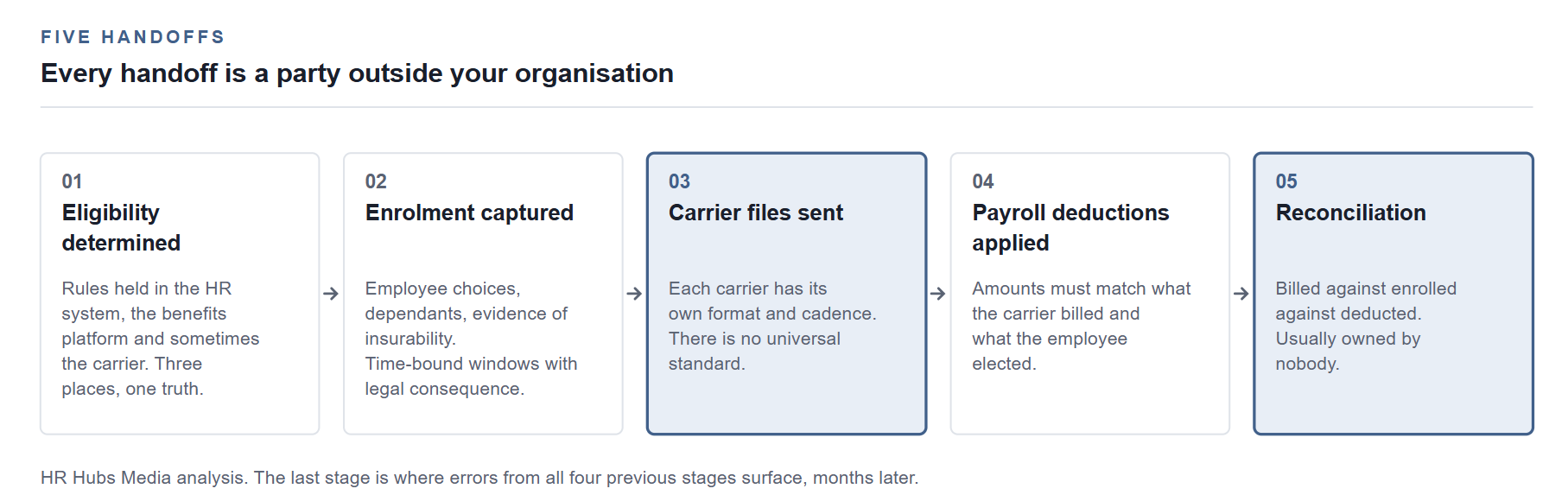
Benefits administration is the only part of the HR stack where most of the counterparties are external, each with their own file format, cadence and error handling.
Benefits administration receives less attention than any other part of the HR stack and generates a disproportionate share of the problems. The reason is structural: it is the only area where most of the counterparties are outside the organisation, each with their own systems, formats and tolerance for error.
It gets budgeted as a configuration exercise. It is an integration programme with legal consequences.
1. Eligibility lives in more than one place
Eligibility rules typically exist in the HR system, again in the benefits platform, and sometimes a third time at the carrier. Each was configured at a different point by different people, and the rules drift.
The drift is invisible until an employee is enrolled in something they are not entitled to, or excluded from something they are. Both are discovered at claim time, which is the worst possible moment for everyone involved.
Decide which system is authoritative for eligibility, document it, and build the others to consume rather than to hold their own logic. This is unglamorous and it eliminates most of the category's failure modes.
2. Carrier files have no standard
Every carrier has its own file specification, its own cadence, and its own idea of how to handle a mid-period change. There is no universal interchange format that removes this work.
The practical consequences are that each carrier connection is bespoke, that a change at the carrier's end can break a file without warning, and that failures are frequently silent. A file that transmits successfully but is rejected downstream will not necessarily produce an alert anyone sees.
Ask, for every connection, what happens when a file fails and who is told. If the answer is that the carrier will contact us, that is not error handling.
3. Life events arrive late
Marriage, birth, divorce, bereavement. Each triggers eligibility changes within a defined window, and each is reported by the employee at a moment when reporting it is not their priority.
The systems assume prompt notification. Reality does not supply it. Retroactive processing is therefore not an edge case, it is normal operation, and a platform that handles retroactive changes badly will generate work every month rather than occasionally.
Test retroactive processing during evaluation, not during the first open enrolment. Ask the vendor to demonstrate a change backdated across a payroll period and a carrier file that has already been sent.
4. Reconciliation is owned by nobody
Three numbers should agree: what the carrier billed, who is actually enrolled, and what was deducted from payroll. In many organisations nobody compares them systematically.
The result is a slow accumulation of terminated employees still being billed for, active employees whose deduction does not match their election, and dependants who were added at the carrier and never in payroll. Each is small. Aggregated over a year they are material, and they surface during an audit or a carrier renewal rather than in the ordinary course.
Assign the reconciliation to a named person with a monthly cadence. It is the single highest-return control in benefits operations and it costs nothing to establish.
5. The data crosses borders and legal categories
Benefits data includes information about health, dependants and family circumstances. In most data protection regimes some of that is a special category attracting additional conditions, and it commonly flows to carriers and administrators in other jurisdictions.
The questions to settle before an integration is built rather than after: what is the lawful basis, what is transferred to whom, on what safeguard where it leaves a jurisdiction, how long each party retains it, and what happens on termination of the carrier relationship. Retention at carriers is the one most often left undefined.
A sequence that prevents most of this
Establish the authoritative source for eligibility before configuring anything. One system holds the logic; the others consume it.
Inventory every carrier connection with its format, cadence, owner at both ends and failure behaviour.
Test retroactive life-event processing during vendor evaluation.
Stand up monthly three-way reconciliation from month one, with a named owner.
Document the data flows and legal basis for special category data before the first file is sent.
Agree what happens at carrier change, including data retention and return, while you still have negotiating leverage.
None of this is difficult. It is simply never on the plan, because benefits looks like configuration and behaves like integration.
This is reporting on workplace technology and operations. It is not legal, employment or procurement advice.
References
Every figure and legal citation in this article is drawn from the sources below. Where an instrument is proposed rather than in force we say so in the text.
European Union, Regulation (EU) 2016/679, the GDPR, Article 9 on special categories of personal data. https://eur-lex.europa.eu/eli/reg/2016/679/oj
Government of India, The Digital Personal Data Protection Act, 2023. https://www.meity.gov.in/data-protection-framework
How we work. This article was researched and written by the HR Hubs Media editorial team. We do not republish press releases. Every number and legal citation is checked against a primary source, which is named and linked above. Where an instrument is proposed rather than in force, we say so. Corrections are made openly on the article itself, never by silent edit. If you believe something here is wrong, write to info@hrhubsmedia.com and tell us what and why.
Filed under Total Rewards & Benefits · Get The Weekly Brief